
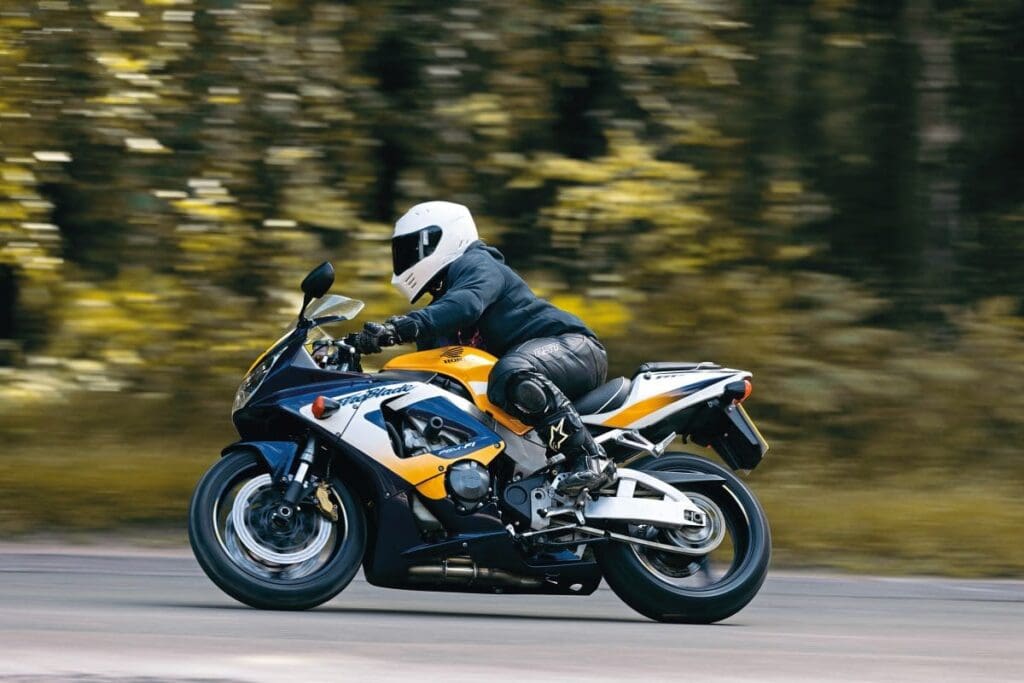
For the 2000 model year, Honda gave their best selling CBR900RR FireBlade a massive overhaul, but was it anywhere near as good as Yamaha’s class-leading YZF-R1?
Words: Bertie Simmonds Pics: Gary Chapman, Mortons Archive, Andy Bolas, Bertie Simmonds
Honda’s CBR900RR FireBlade was the archetypal sports-bike of the 1990s and boy did Britain love sports-bikes in the 1990s…
Enjoy more Classic Motorcycle Mechanics Magazine reading every month.
Click here to subscribe & save.
Most of the best sellers of the decade were machines of a sporting bent – with the odd budget naked (such as Suzuki’s excellent Bandit family) thrown in for good measure. And if you wanted a sports machine – and most of us did – you had plenty to choose from whatever your experience or even the type of licence you had.
The fledgling riders had the 125cc two-strokes, often thrashed and crashed and bedecked with an L-plate, but once you passed your test, the motorcycling world was your oyster. You could choose from two-stroke race-replica 250cc bikes, or their four-stroke 400cc equivalents – many of these brought into the UK as grey imports as they often weren’t officially brought in by the manufacturers for long. The four-cylinder 600cc ‘supersports’ class often offered the best mix of power, performance, and price; the 750cc ‘superbike’ class had similar inline or V4 machines to the ones we would see racing at weekends, while the litre class would consist either of monsters like Suzuki’s GSX-R1100, rapid sports-tourers like Kawasaki’s ZZ-R1100, or the more agile Yamaha FZR1000 Genesis and EXUPs. Course, if you were loaded you’d have a Bimota or maybe a swanky Ducati V-twin…
Whatever bike you had or saw as the next step up, the FireBlade was the daddy.
From launch in 1992 at least up until the advent of Yamaha’s YZF-R1 in 1998, saying you had a ‘Blade’ gave you lots of two-wheeled kudos, but by the end of the decade it had to have a major revamp to get close to the Yam.
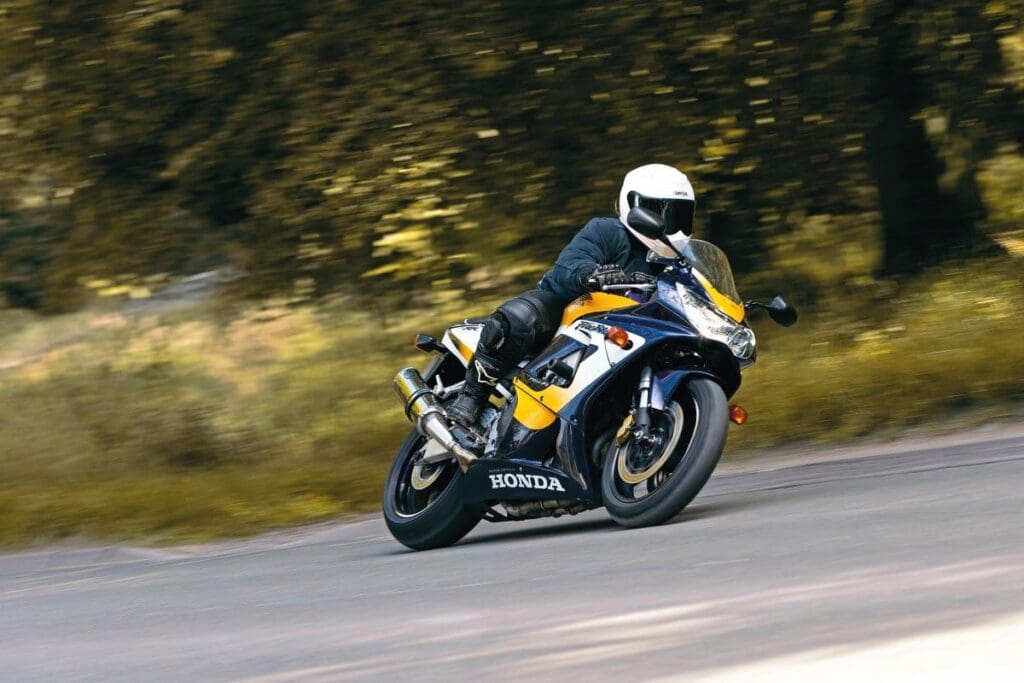
The CBR900RR had been tweaked three times before the turn of the millennium, but the 2000 model had to be something radically different. And it was – and wasn’t.
It’s said that Tadao Baba – the designer and project leader of the FireBlade – always had a plan to up the capacity of the bike itself to under a full litre and it had gone from 893cc (1992) through to the 918.5cc (1996) and then become the 929 for 2000 – still somewhat under-gunned compared to the 998cc R1. So, while the engine was a development of what went before, it wasn’t quite all-new – the original architecture was still there but with some new bits added.
Firstly, the motor was finally fuel-injected and the motor itself was more compact, and positioned further forward in the frame in an attempt to improve the bike’s handling. The bigger bore and shorter stroke meant the new Blade could rev harder and faster, with forged aluminium pistons which, although bigger, weighed almost exactly the same as the cast aluminium ones which they replaced. The hollowed-out camshafts were also 20 per cent lighter, giving the motor a sharper response on the throttle, while a new cylinder head design improved airflow.
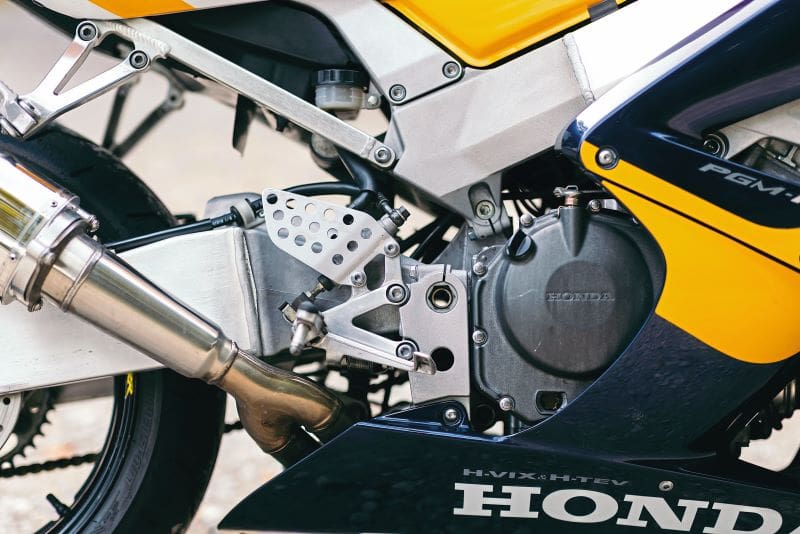
As well as electronic fuel-injection, the 929 Blade came with an electronically-operated intake and exhaust valve system – the Honda Variable Intake/Exhaust Control System (H-VIX) for the best performance at both low and high revs. Yes, you’re right, it was basically Honda’s EXUP valve.
The chassis was lighter and now featured what was called a ‘semi-pivotless frame’ where the main frame rails didn’t actually join on to pivot plates on the (much longer and beefier) swingarm. The swingarm design also came pretty much directly from 500cc GPs, where Honda’s NSR500 ran a longer swinger for improved traction – the R1 had already employed such a trick.
The first few incarnations of the FireBlade had a bulbous fuel tank which you had to reach over, but for the 2000 model that tank was slimmed and repositioned to aid mass centralisation. This was a buzz phrase of the original machine but technology had moved on, meaning that the 17-inch front wheel and upside-down/inverted forks that Baba-san had eschewed for a 16-inch and right-way-up forks of the original were gone. In their place lightweight inverted 43mm forks came in, as did a more fashionable 17-inch front wheel.
Aesthetically, the FireBlade had traditionally been a real looker. The original was all twin-headlamp and drilled fairings for lightness, replaced by the ‘foxeye’ models with sharks gills in the tail-unit.
Then when the Blade really needed to look sexy – when the R1 came out – instead Honda had the 1998-1999 RR-W/X model, which was a softer model all-round and not the sharp looker the previous models had been…
You’d expect then that the ‘Millennium Blade’ would be a real looker, but, well, it isn’t really… The face of the bike now has a single headlight assembly, rather than the twin-beamers of old. And – sporty-looking as this bike is – back then, we didn’t think this model FireBlade (CBR900RR-Y and for 2001 the RR-1) was a patch on the R1 looks-wise. And we still don’t… I also think this particular model year had only one good colour scheme – the all black/gunmetal model, with this blue/yellow being the worst. But handsome is as handsome does, so let’s go for a ride…
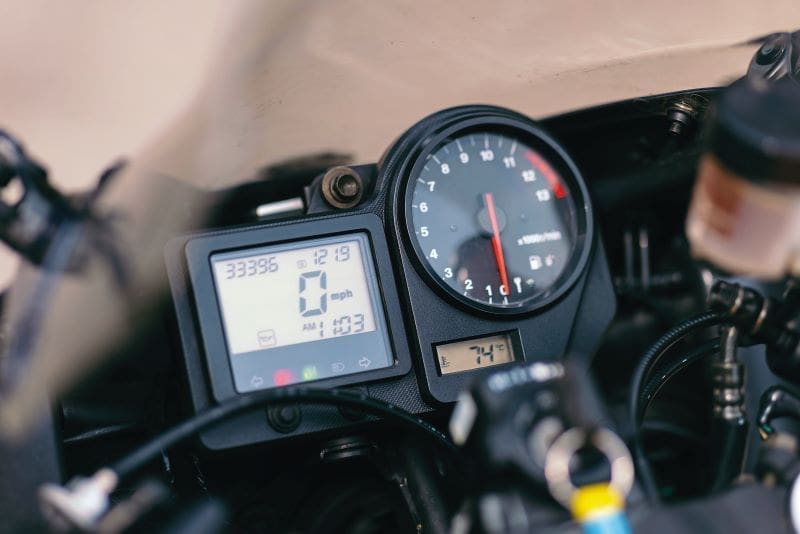
The original Blades had cockpits quite reminiscent of the early GSX-Rs – they were sporty and they were basic, with the main clocks surrounded by racey foam, but things had moved on during the 1990s with miniaturisation and the like – as shown with the R1’s pleasing LCD digital/analogue mish-mash. The Blade is now no different, as the dash incorporates a digital speedo as well as a small temperature gauge and clock, which, despite being a bit dim, was easy to read. Sadly, by 2000/2001 there still wasn’t a gear position indicator on board so Acumen and the like would make a few quid here over the years, but at least by now we had a way of telling the time, thanks to the LCD clock. While the clocks and controls (typical Honda of the time) are typically clear and crisp in operation, the whole cockpit does seem a touch drab, but then they were back then. Oh, and while we’re sat here look into the mirrors… That’s right, they’re quite big and show you a lot of what’s happening behind. Which is handy.
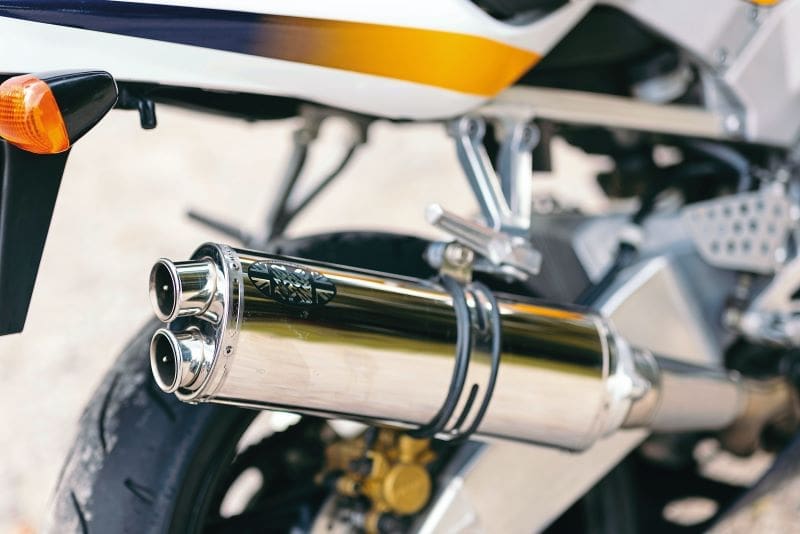
Thumb the starter and the bike immediately chimes into life, soon settling into a turbine-smooth burble. Having intimate knowledge of these bikes (see boxout) as standard there’d be no glorious cacophony coming out of that end can… And the standard can is a bit of a whopper, but – thankfully – today we have a Max Torque Can on the end of this Blade… And boy does it sound good.
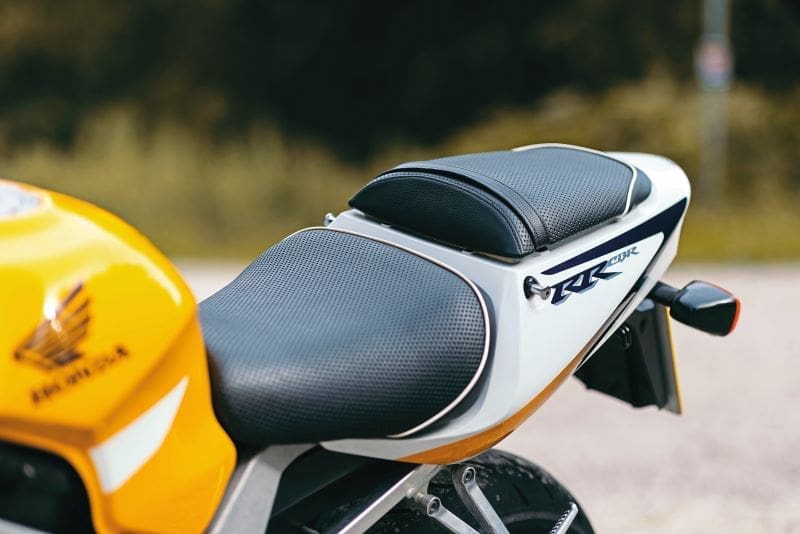
If you ride the 929 against earlier Blades you’ll find the ergonomics are better. Over the years from 1992 through to 1999 Baba-san and his team were listening to feedback from owners and most of them seemed to tell him to make the bike easier to ride and more comfy. The 929 is a further step in this direction. It’s comfortable enough for a sports-bike and spacious; there’s not a twinge in that wrist or an ouch in that ankle you can get with some sporting machines. It’s snug, but you can move around and the slimmed-down tank helps with this; it helps you feel in control of the bike. How many uncomfortable bikes make you feel the opposite? Honda aren’t daft… and I will wager that the aftermarket seat is more padded than the original, adding to the overall feeling and pushing you just that little bit more over the tank.
Time to tug on the clutch lever, which is nice and light being cable-operated, and a gentle prod gets her into gear. It’s lift-off time…
Ah… okay, here’s the thing: at slow speeds you really need to be spot-on with the throttle and clutch. If you’re meandering through town, you’ll find the initial pick-up of the fuel-injected four a little snatchy. Not so much as to spoil the ride, but you’ll just be wary of it and alter your riding accordingly. In the late 1990s carbs were being phased out – ironically just as they were utterly brilliant. Fuel-injection had to come thanks to more stringent emissions and it would take time to get it working across the whole rev-range.
Get the bike out of town and you’ll be fine. Oh, more than fine. As the revs climb and go past 5000rpm the bike starts to come alive and make real sense. The power comes in nice and smooth – especially when you get the chance to experience the top-end of the rev-range, say, from 7000rpm up, where it seems Honda’s PGM-FI system really is in its sweet-spot. Backing off a bit and cruising does get the old hands tingling and it’s a feeling I get with some bikes. My time with my Blade was the same and I always wondered if it was my hands only that started to tingle at motorway cruising speeds and constant throttle openings…
The numbers of this beast were around 150 claimed brake horses, which – oh what a surprise – wasn’t far off what was being touted for the R1 of the time. I’d love to know what this one makes right now. I recall dyno tests of my very own one and it was a respectable 128bhp at the back wheel. Not bad, even today… But (as the saying goes) ‘power is nothing without control’. Back in 2000/2001 you’d probably feel less scared riding a Blade compared to the R1 and definitely compared to the-then new boy, the Suzuki GSX-R1000 K1. I’d still stand by this, but there are times when the FireBlade perhaps isn’t quite as laser-like or scalpel-smooth as you’d like.
Things can get a bit out of shape when you hit the lumps and bumps in the road when you’re on the throttle. Now, I know we can say this of any 128bhp, 190-kilo (wet) sports-bike but it can be a tad disconcerting. I used to have many such issues back in the day – thank gawd I’m slower and more cautious. But then the Blade inspires confidence rather than fear, so you feel like you can ‘go for it’ in a way maybe you wouldn’t with the GSX-R1000?
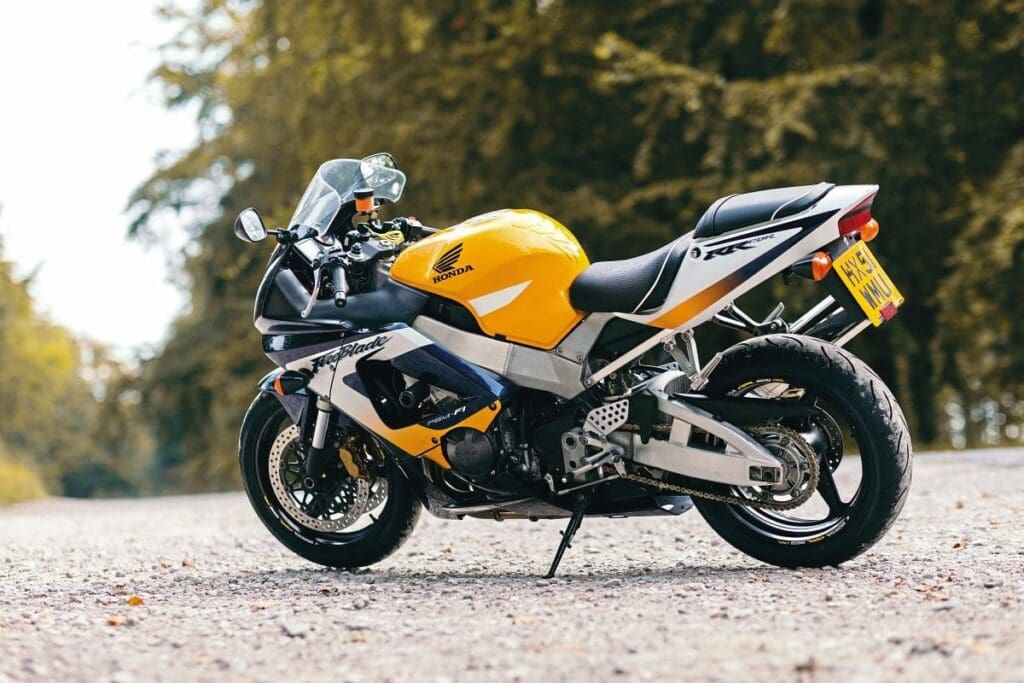
Handling is sharp – it’s a Blade after all – but it was probably the most nimble litre sports tool back then, too: 1400mm of wheelbase, 23.8 degrees/97mm rake and trail compared well enough with the R1 of the time (1395mm 24/91), but the FireBlade always seemed to have the edge on track or on road, even if it didn’t have the outright grunt of the competition. The move to 43mm upside-down forks clearly worked and today these still feel good with the rear Pro-Link unit also working very well.
Both front and back suspension are fully adjustable. Interesting factoid: John McGuinness once rode my bike around the TT course in 2001 when the event was cancelled due to Foot and Mouth. He reckoned the best suspension settings were as follows… Rear: Two more clicks of compression from standard, and an extra full turn of pre-load. Front: Drop yokes 2mm, leave settings standard. So there ya go…
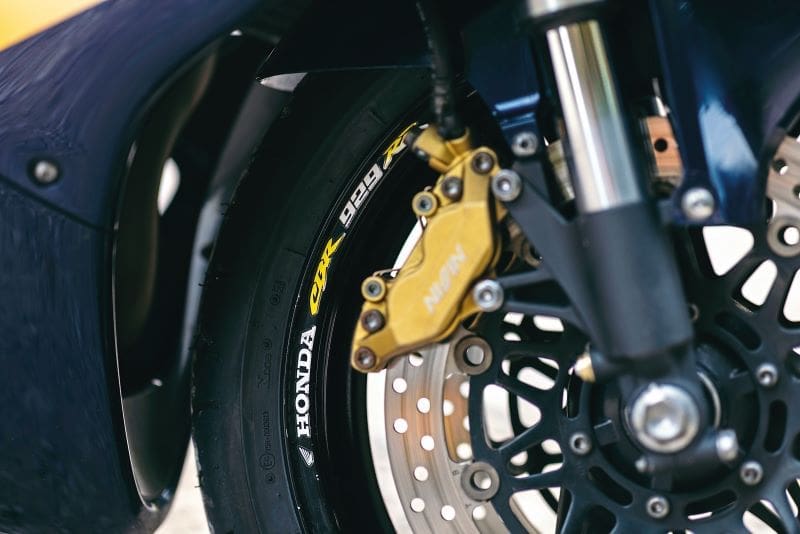
Where the FireBlade did outrank the others was on the brakes… And – oh – those four-pot Nissins and 330mm discs up front are still good today – probably thanks to this bike being formerly fettled by our very own Andy Bolas. He doesn’t sod about… As new, these brakes were class-leading – easily eclipsing both the Sumitomo ‘blue spot’ calipers on the R1 and the maligned six-pot Tokicos of the GSX-R. As I recall, lots of use would mean you needed to regularly strip, clean and maintain the brakes. These on this bike today are wonderful.
As we’ve touched on issues, there are some more. As well as keeping an eye on the brakes, that engine/exhaust valve can seize up, just like the EXUP valves can on the Yamahas. Also, while the gear-box is solid (can clunk a bit), second gear has been known to give issues. Obviously the snatch of the motor low-down can be ironed out with adjustments to the injection system and associated ECU, and apparently a filter on the fuel-pump can block, causing rough running.
Having owned and run many FireBlades (and Fireblades – the CBR1000RR of 2004-on dropped the capital ‘B’) I’ve got my faves and not so faves. A few stolen hours on this 51 plate, 33,000 miler has left me impressed and given me a touch of nostalgia. Yes, it’s not the looker the R1 was/is, but the looks have grown on me again. My own was yellow, but they also did some nice colour schemes (such as the 2001 Special Edition silver) which really flatter the bike’s lines a bit more than the launch colours did… And while I don’t go for tat on a bike, the aftermarket can sounds good on this one and the wheel trim/bar-end weight look quite classy.
Price-wise it’s good news. These are way cheaper (and yet better) than the iconic launch models and later Foxeyes and – sandwiched between the lacklustre RR-W/X of 1998/1999 and the much-loved 954 of 2002-2003 – they seem a tad forgotten. Rough examples start at a grand and half-decent bikes can be had for £2000-£3000.
Me? Well, if I could find my old 929, I may be sorely tempted… Try one.
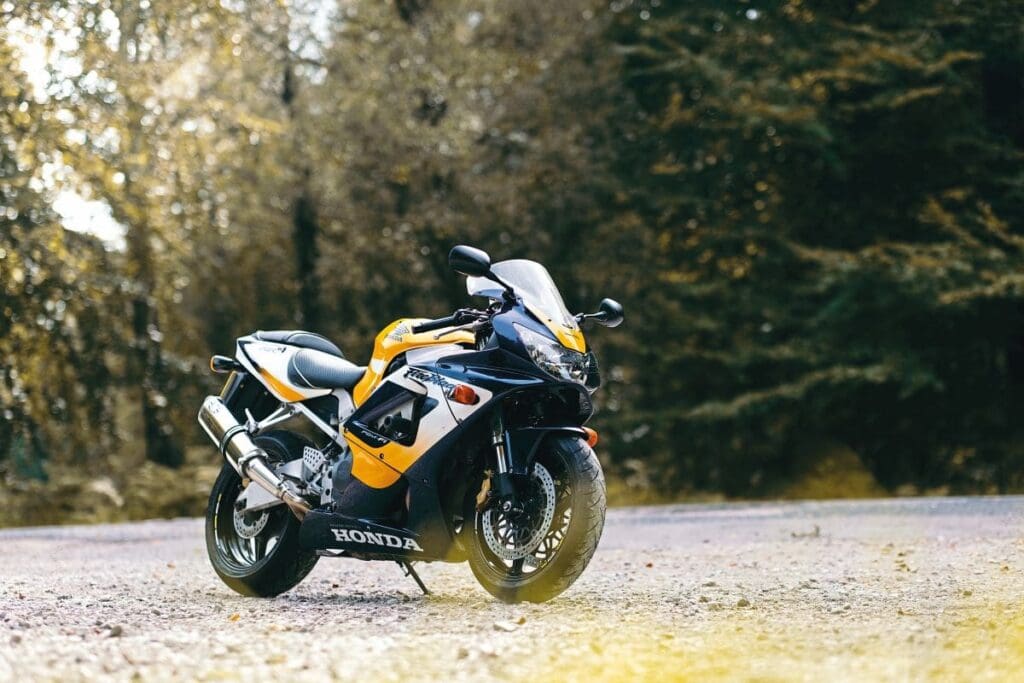
Bert’s Blade…
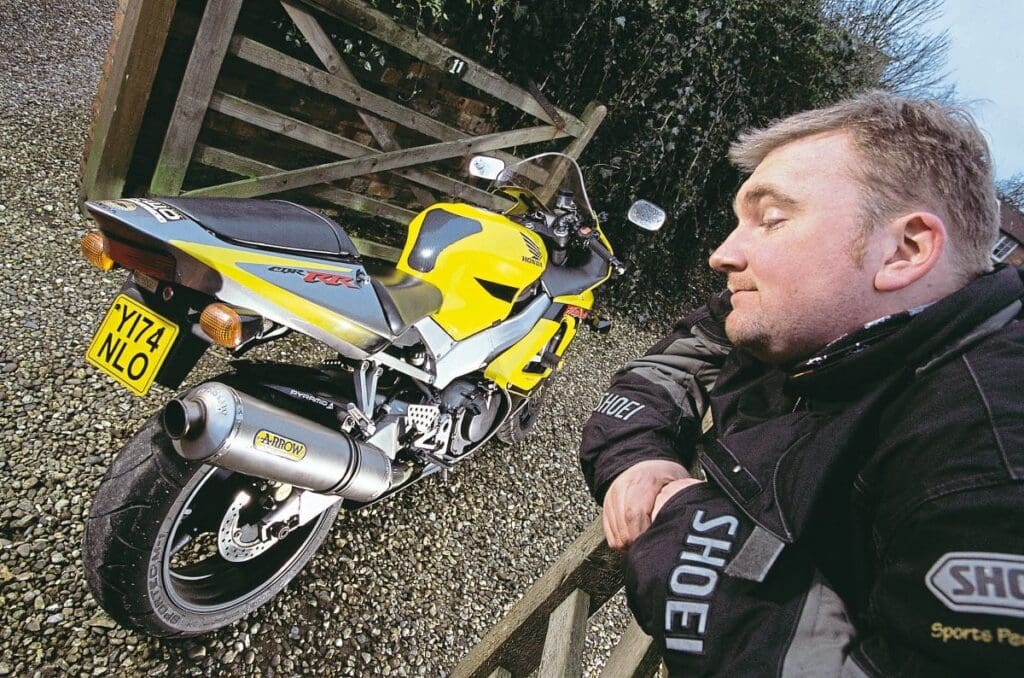
My first encounter with the CBR929RR was a very pleasant ride home before a big ‘litre-class’ sports-bike test Bike magazine were conducting on the likes of the Blade, Yamaha YZF-R1, Honda VTR1000 SP1, and Kawasaki ZX-9R at Castle Combe in 2000.
Where the R1 and the SP1 could come in for some criticism for almost being ‘too much’ on the road (even back then), the Blade was more easy going, even if the bike still had that legendary quick-turning feel from the original bike. It was the same on track, too – even if it lacked the outright performance of the R1. For many, it and the 9R were the bikes of choice for the wet ride home. I had a red/white/blue RR-Y for a few thousand miles and loved it.
By 2001 I was on Two Wheels Only magazine and was lucky enough to get the RR-1 in yellow. It’s fair to say I loved this bike and went everywhere on it: just me and a Givi Voyager roll bag bungeed on the pillion. More than 11,000 miles in around eight months (700 miles a week commuting) revealed a few things.
Firstly, yes, that PGM-FI fuel-injection could be snatchy at low revs and a tad hesitant off the throttle. Also, at motorway cruising speeds there were some notable vibes at 5-6000 revs through pegs and bars which could get your fingers tingling, even leading to numbness. Those Nissin brakes were great – but riding in winter meant you had to strip and clean them every few thousand miles.
I didn’t really do anything to the Blade (didn’t need to) apart from a double-bubble screen, Pyramid hugger, crash bungs, a bolt-on and an Arrow slip-on can, which worked fine even without a Power Commander. We even did a fair few track-days (mainly at Donington Park and Cadwell) and John McGuinness even took it around the Isle of Man, but the most impressive thing was the build quality. The standard of finish when I’d cleaned her was impressive. And you could fit chunky Bert-sized waterproofs under the pillion seat.
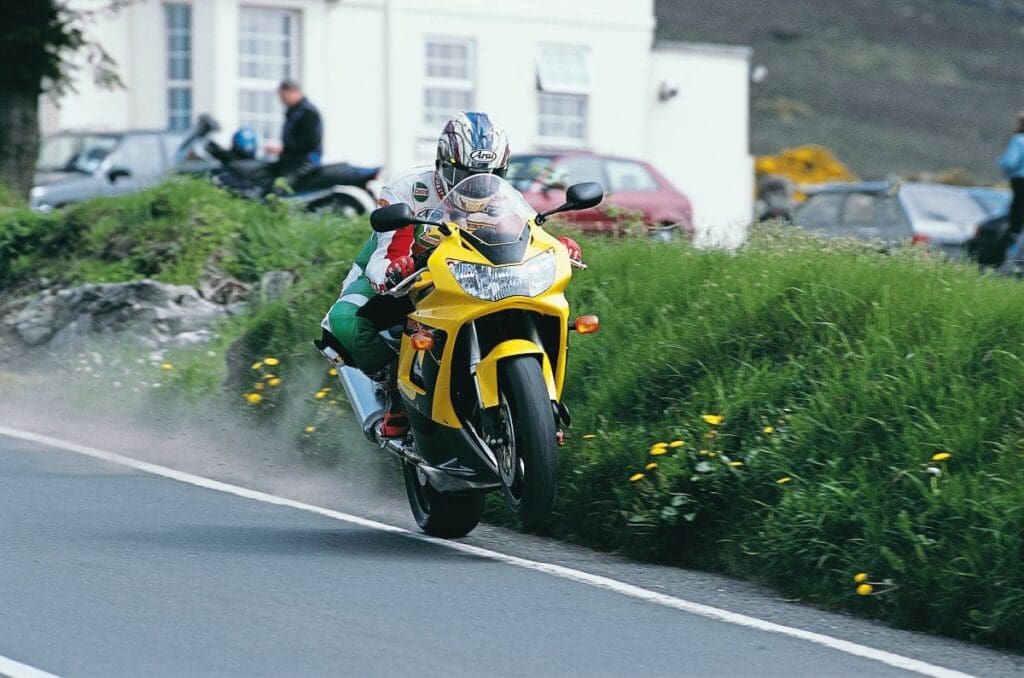
This very FireBlade…
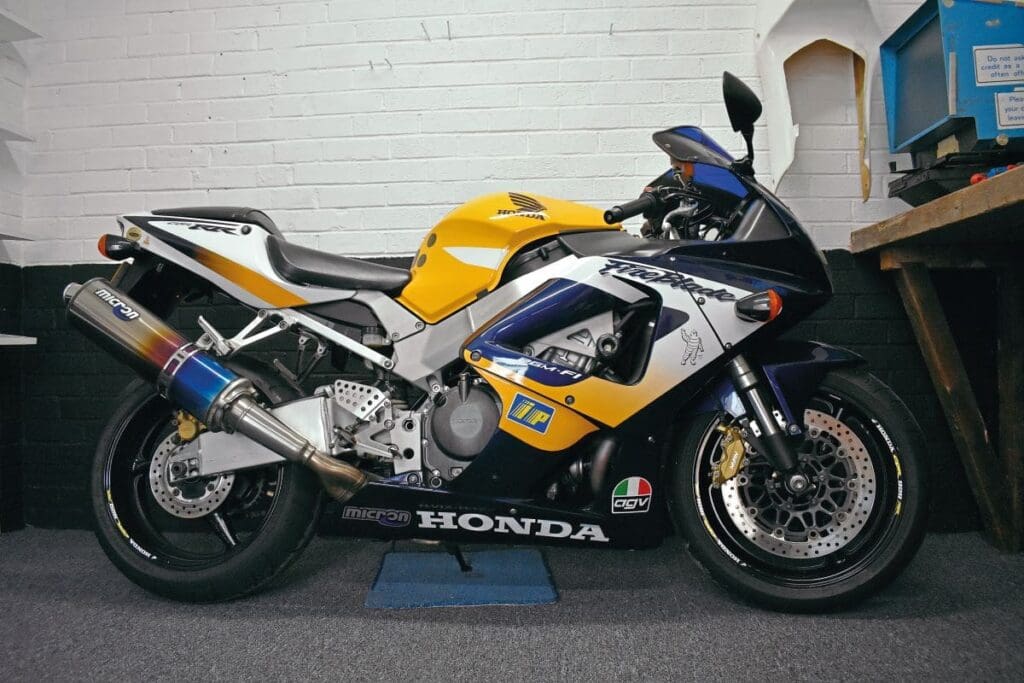
This very nicely turned out Honda CBR900RR-Y FireBlade was bagged by our own Andy Bolas for £1000…
Yes, just a grand and, of course, he’s sorted out the issues, which were many. First of all it was fairly tatty and bedecked by stickers, some of which were doubtless hiding some issues. The tank had some damage on it; a rattling sound was coming from the H-TEV (powervalve) section of the exhaust; it had a 20-year-old alarm on it; an awful blue screen; old blue-coloured Micron end can; and it also had some iffy rusty bits and pieces.
The alarm removal sorted the battery drain problem and from then Andy gave the bike some serious TLC along with new fasteners. He also got an H-TEV blanking plate from Max Torque Cans and he sorted the cam-chain tensioner – which was a pain of a job. He also cleaned out the K&N air-filter, gave the bike a full service and new tyres and cleaned the oil-sight glass.
The bike and all the bits and pieces came to a tidy £1412.60 – but the finished bike is well worth around £2500 – and, of course, Andy B swopped it for a Honda VFR800! Riding this bike shows what a little money and a lot of time and effort can do. Well done mate…