
Advertisement Feature – We have received payment for the contents of this article. Learn more.
When comparing braking systems between cars and motorcycles, the fundamental differences become clear immediately.
The Audi A4 B8, weighing-in at over 1.5 tonnes, uses large ventilated brake discs with multi-piston calipers designed for smooth, controlled stopping power. Meanwhile, the Yamaha YZF-R6 relies on lightweight dual-disc front brakes with radial callipers, engineered for instant response and maximum efficiency despite its significantly lower weight.
Enjoy more Classic Motorcycle Mechanics Magazine reading every month.
Click here to subscribe & save.
Both vehicles achieve the same goal – safe, effective braking – but through completely different engineering approaches. The car prioritises comfort and stability for everyday driving, while the motorcycle focuses on precision and immediate response for high-performance situations.
How car brakes handle heavy weight
The Audi A4 B8’s braking system must manage substantial mass during deceleration. Its front brake discs typically measure 312mm in diameter, featuring internal ventilation channels that dissipate heat effectively. The system includes four-piston front callipers that distribute braking force evenly across larger brake pads.
According to automotive testing data, the A4 B8 achieves a stopping distance of approximately 35-38 metres from 60mph under optimal conditions. This performance relies heavily on the brake assist system and electronic brake force distribution, which automatically adjusts pressure to each wheel based on load distribution and road conditions.
The Audi A3 advanced brake disc system shares similar design principles, using comparable ventilated disc technology scaled appropriately for its lighter weight class. This demonstrates how manufacturers adapt core braking technologies across their model ranges.
Motorcycle braking precision over power
The Yamaha YZF-R6 takes a fundamentally different approach. With a kerb weight of just 190kg, it can achieve remarkable stopping distances – often under 30 metres from 60mph. The twin 320mm front discs work with six-piston radial calipers, providing exceptional feel and modulation.
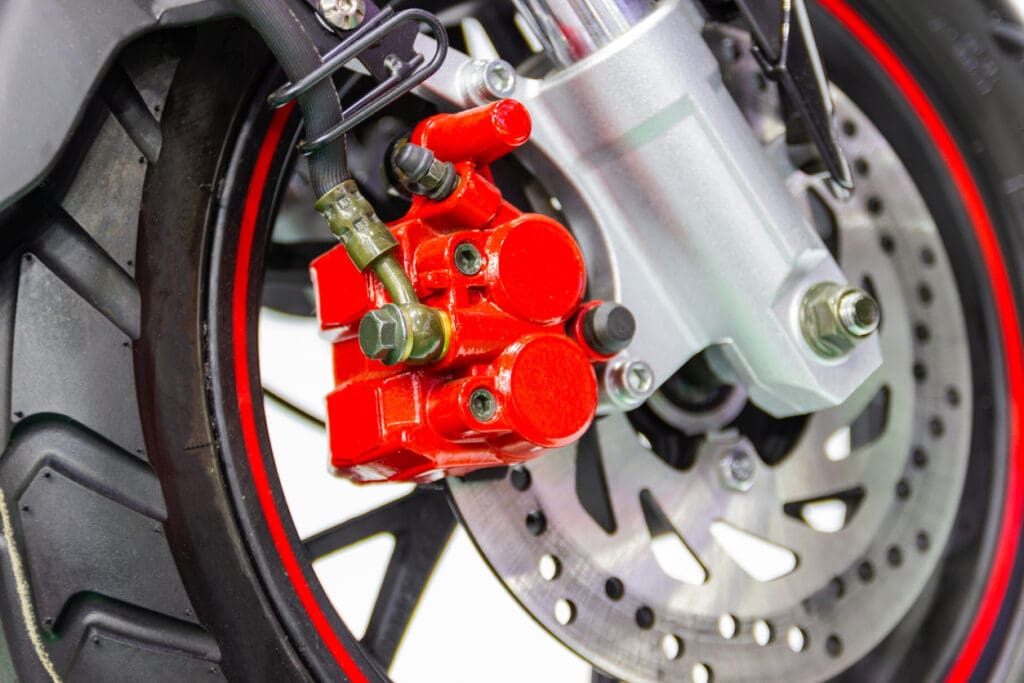
Steel braided brake lines replace rubber hoses to eliminate expansion under pressure, ensuring consistent lever feel. The single 220mm rear disc, while smaller, provides crucial stability during hard braking by preventing rear wheel lift.
Professional motorcycle testing shows that sports bikes like the YZF-R6 can achieve deceleration rates exceeding 1.0g, comparable to or better than most cars, despite having only two contact patches with the road.
Performance comparison analysis
| Vehicle Type | Stopping Distance (60-0 mph) | Brake Disc Diameter | System Weight | Deceleration Rate |
| Audi A4 B8 | 35-38 metres | 312mm front | ~45kg | 0.8-0.9g |
| Yamaha YZF-R6 | 28-32 metres | 320mm front | ~8kg | 1.0-1.2g |
This comparison reveals fascinating insights into braking system design philosophy. Despite the Audi’s larger total brake disc area and more complex multi-channel ABS, the Yamaha achieves shorter stopping distances through superior power-to-weight ratios.
The motorcycle’s lighter brake components allow for quicker heat dissipation per kilogram of vehicle weight, while the car’s heavier system provides consistent performance across varied loading conditions. The data demonstrates that effective braking isn’t simply about raw stopping power, but about matching system characteristics to vehicle requirements and typical usage patterns.
ABS technology for different challenges
Modern ABS systems highlight the contrasting requirements between cars and motorcycles. The Audi A4 B8’s ABS works alongside electronic stability control, preventing wheel lockup while maintaining directional control. The system monitors wheel speeds 100 times per second, adjusting brake pressure to individual wheels.
Motorcycle ABS faces unique challenges. The YZF-R6’s ABS must account for lean angles during cornering, preventing front wheel lockup that could cause catastrophic crashes. Modern motorcycle ABS systems use lean-sensitive sensors to adjust intervention thresholds based on the bike’s angle.
Motorbike ABS is also a great safety enhancement that has revolutionised motorcycle safety. Studies show that motorcycles equipped with ABS have 31% fewer fatal crashes compared with non-ABS models, making it a crucial safety feature for riders.
Brake system components
The diagram illustrates fundamental differences in brake system architecture between cars and motorcycles.
The Audi A4 B8 employs a brake servo system that amplifies pedal force, allowing drivers to achieve maximum braking with minimal effort – essential for a 1.5 tonne vehicle. The system uses rubber brake lines that flex slightly under pressure but provide adequate performance for road use.
In contrast, the Yamaha YZF-R6 relies on direct hydraulic pressure without servo assistance, requiring stronger rider input but providing superior feel and feedback. Steel braided brake lines eliminate expansion under pressure, ensuring consistent lever response during aggressive braking. The radial-mounted callipers align forces more efficiently, reducing flex and improving precision – crucial for a vehicle where milliseconds matter in emergency situations.
Engineering excellence in different forms
Both vehicles demonstrate how manufacturers optimise braking systems for their specific applications. Cars prioritise consistent performance across varied load conditions and weather, while motorcycles focus on maximum performance with minimal weight.
The Audi’s brake system includes features like brake disc deoxidation systems and automatic pad adjustment, designed for minimal maintenance over extended periods. The Yamaha’s system emphasises immediate response and fade resistance under extreme conditions.
Expert analysis and recommendations
According to automotive experts at AUTODOC, understanding these differences helps vehicle owners maintain their braking systems properly. Car owners should focus on regular brake fluid changes and pad replacement, while motorcycle riders need to pay particular attention to brake line condition and lever adjustment.
Both systems represent decades of engineering development, with each manufacturer continuously refining their approach based on real-world performance data and safety requirements.
The key takeaway is that effective braking isn’t just about stopping power – it’s about matching the system to the vehicle’s specific needs and operating conditions.
FAQ: How do car and motorcycle braking systems work?
🚗 How does a car’s braking system cope with heavy weight?
The Audi A4 B8 braking system is designed for a weight of over 1.5 tonnes.
The front ventilated discs with a diameter of 312 mm and four-piston callipers distribute the load evenly. Additionally, a brake booster, brake assist system and electronic brake force distribution (EBD) ensure safe and stable stopping.
🏍 Why do motorcycles brake faster than cars?
The Yamaha YZF-R6 weighs only 190 kg, so its braking system is focused on instant response.
Dual 320 mm front discs with radial six-piston callipers and steel-reinforced hoses provide a high level of control and a short braking distance (28–32m from 60mph, which is faster than many cars).
⚖️ How do the braking performance of the Audi A4 B8 and Yamaha YZF-R6 compare?
- Audi A4 B8: braking distance 35–38m, deceleration 0.8–0.9g, system weight ~45kg.
- Yamaha YZF-R6: braking distance 28–32m, deceleration 1.0–1.2g, system weight ~8kg.
Despite the Audi’s more massive brakes, the motorcycle wins thanks to its power-to-weight ratio.
🛡 How does ABS work in cars and motorcycles?
- Audi A4 B8: ABS is integrated with the stability control system and monitors each wheel hundreds of times per second, ensuring stability even during emergency braking.
- Yamaha YZF-R6: ABS takes into account the angle of the motorcycle when cornering, preventing the front wheel from locking up. This is particularly important for safety – studies show that ABS reduces the number of fatal accidents on motorcycles by 31%.
🔧 How do brake system components differ?
- Car (Audi A4 B8): brake booster, rubber hoses, multi-piston callipers, ventilated discs.
- Motorcycle (Yamaha YZF-R6): direct hydraulics without booster, reinforced hoses, radial callipers, lightweight discs.
🧰 What advice do AUTODOC experts give on brake maintenance?
- It is important for car owners to change the brake fluid regularly and check the wear on the brake pads.
- Motorcycle owners need to monitor the condition of the brake hoses and the lever adjustment.