
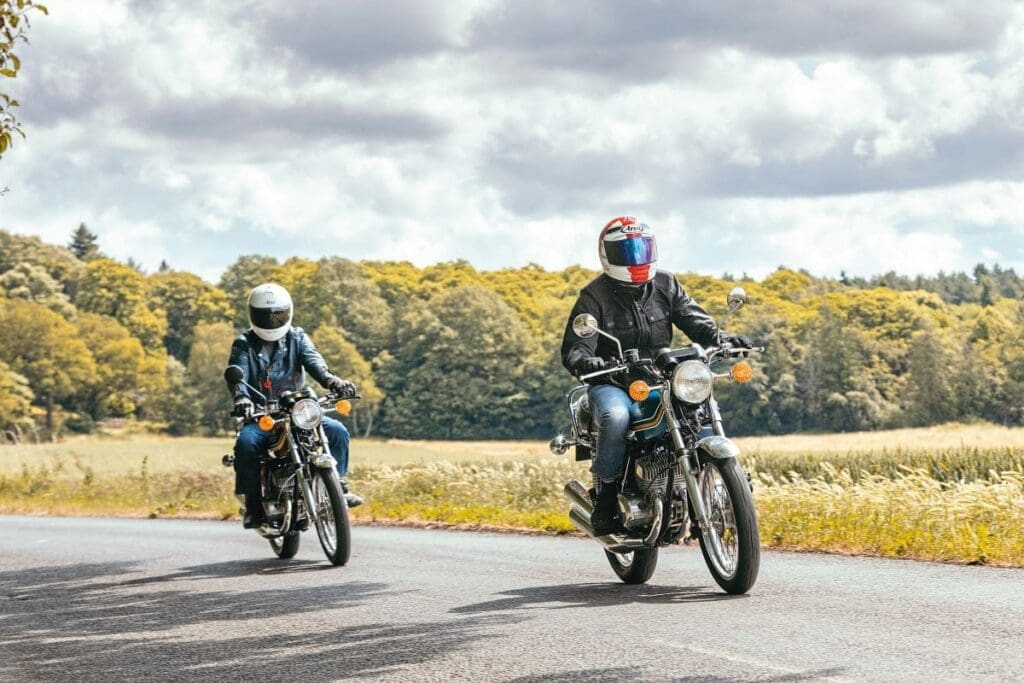
The weather’s good, the roads are clear and he’s got TWO saucy Kawasaki two-stroke triples to play on… Steve Cooper is in heaven!
Words: Steve Cooper Pics: Gary Chapman
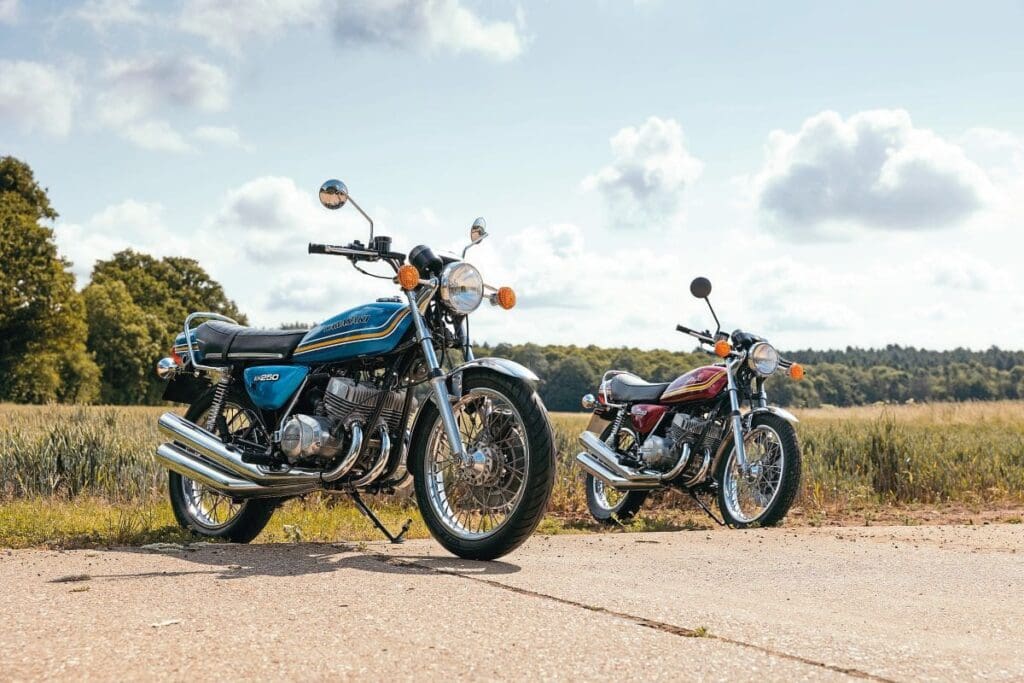
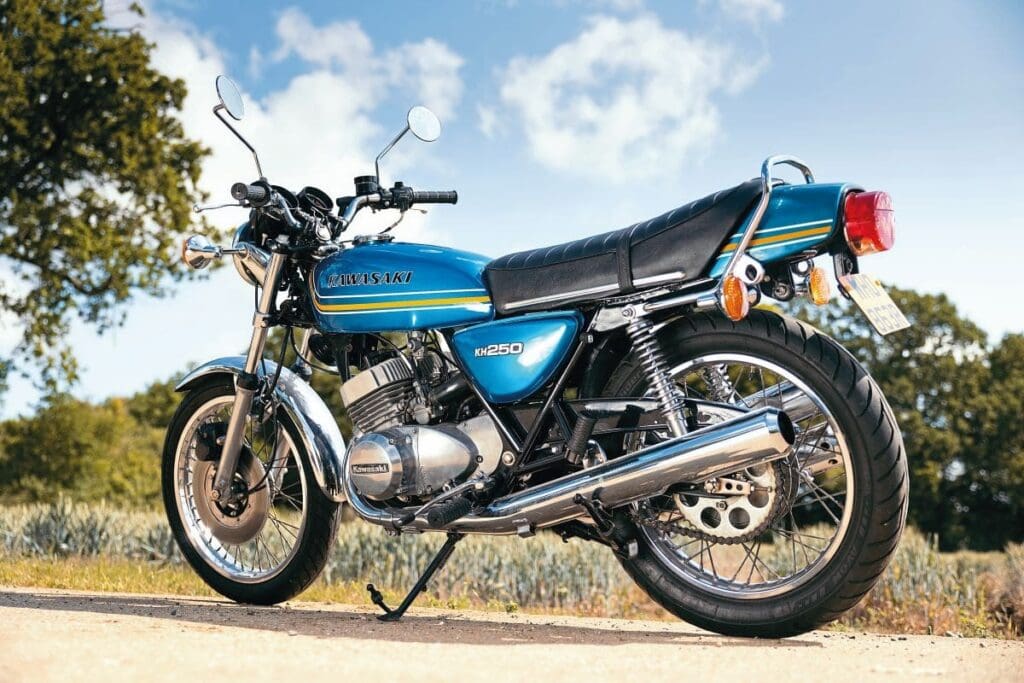
Two Kawasaki KH250s two-stroke triples in the same place on a sunny day – does it get much better than this?
A pair of period 250cc learners as close to standard as you might possibly expect from machines that are regularly ridden – and not an aftermarket ‘spannie’ to be heard! The locals don’t know how lucky they are! Sitting glinting in the sun just as if it’s 1977 all over again, the Candy Sky Blue and Candy Super Red bikes have stood the test of time much better than the contemporary fashions. And, perhaps fortunately, there’re no period soundtracks spoiling the ambience either. No David Soul requesting ‘Don’t Give Up On Us Baby’, Julie Covington isn’t droning on about Argentina and, blissfully, Paul Nicholas hasn’t been reminding us it’s Grandma’s Party Tonight… (Bertie’s note: Scoop, these songs were all from 1976, not 1977…)
Enjoy more Classic Motorcycle Mechanics Magazine reading every month.
Click here to subscribe & save.
Life is good for lads of a certain age and owners Laurence Kelly and Andrew Samways are chatting away swapping tales of derring-do, whiskered plugs, and how not to deck that lower exhaust on the right-hand side.
The reasons for owning a 250 Kawasaki triple are manifold but its maximum performance really isn’t at the top of the list. Other than the ‘massaged’ S1 press bike the model was never fastest quarter-litre learner. No, the bikes sold on looks and the unique number of cylinders and pipes they boasted. With a local Kawasaki dealer nearby and the requisite cash to hand, the lure of the three-ot learner must have been almost irresistible. From 1971 through to 1980 that combination massively aided the sales of a bike that really only just gained a disc brake, changed cosmetically and received minor technical updates. Set against the various and serried changes implemented by rivals Honda, Suzuki and Yamaha, the baby triple was effectively just kept ‘on trend’ and ‘on brand’. Truth be told, Kawasaki knew the days of the two-stroke were numbered globally when the 250/3 morphed from S to KH. Factor in the mutterings from parliament about bringing in a 125cc learner law and why would you update an older model you knew was soon to be pensioned off?
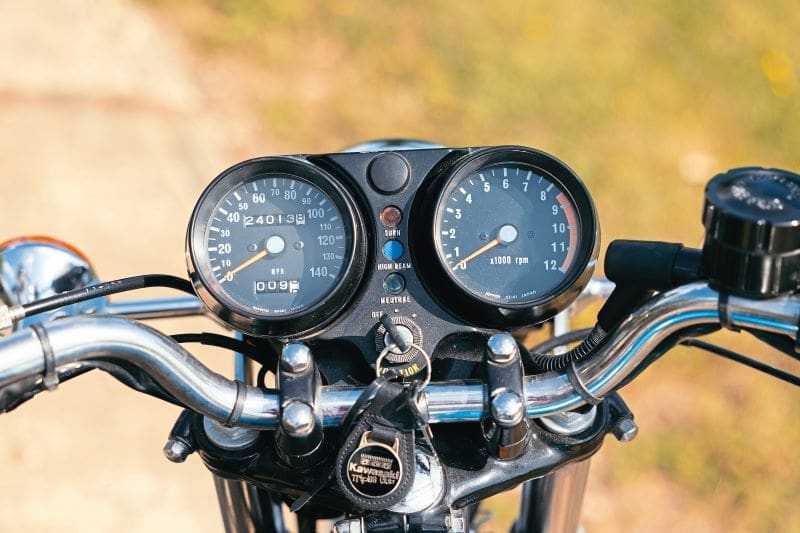
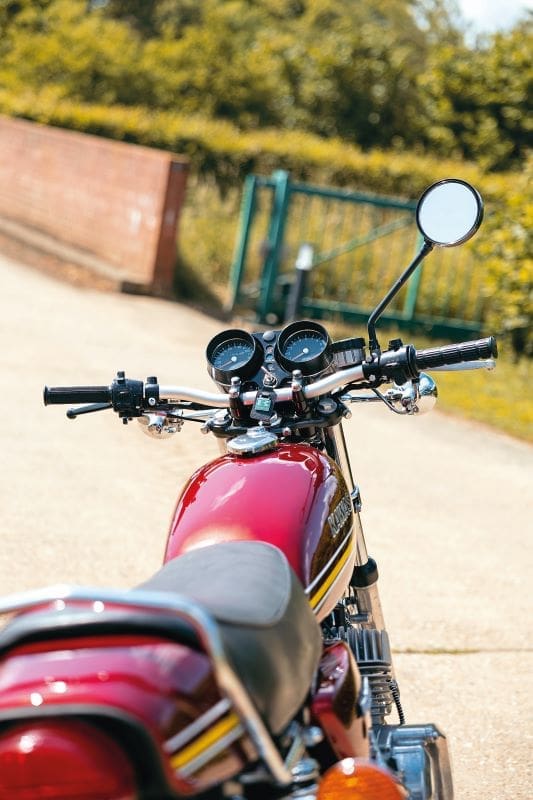
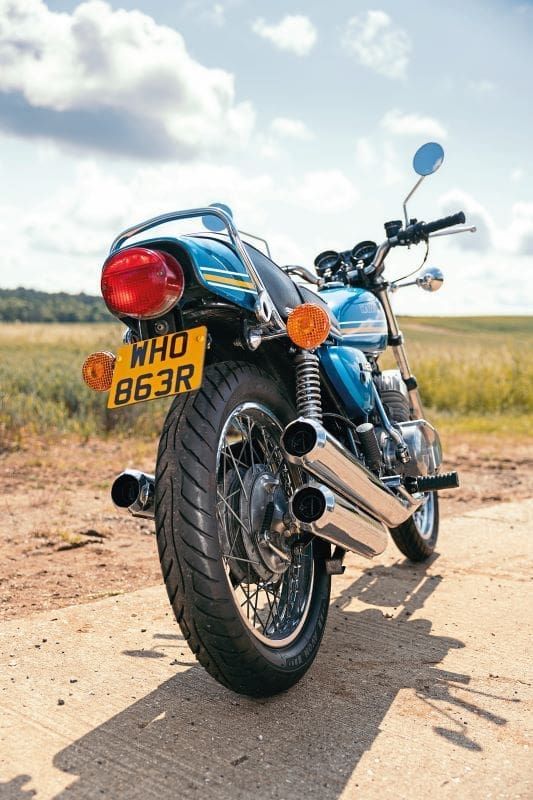
Okay, so much for context – let’s put that aside and go back to looks…which is arguably what most 17-year-olds went by more than anything. Few would argue Kawasaki’s stylists weren’t at the top of their game here. The bikes look like they’re doing 70 em-pee-aitch even when they’re parked up by the side of the road. From those rakishly-angled gauges back to the sculptured tail piece (pretty much a Kawasaki invention) there’s an incipient feeling of movement. The asymmetric rear view that originally looked plain odd soon became a signature, and the way the offside pair run parallel and at an angle is the work of genius. Theoretically, the bike should look unbalanced yet it all works with just the one pipe on the left. Kawasaki always mounted the front guard close to the tyre for a smoother, sleeker, look and many owners simply ditched the rear one to gain a less fussy profile.
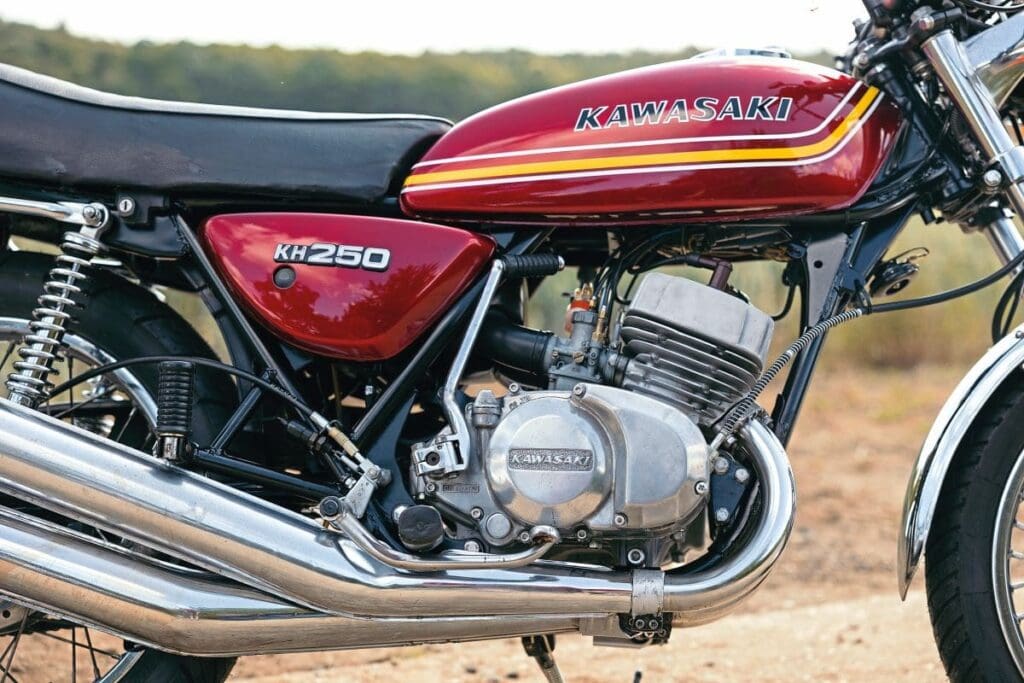
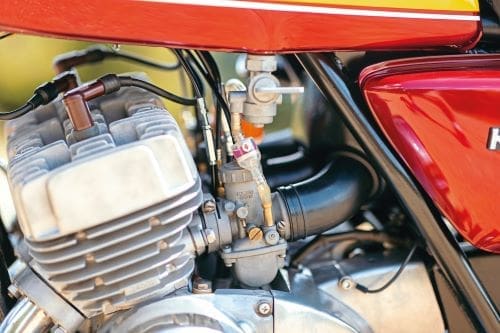
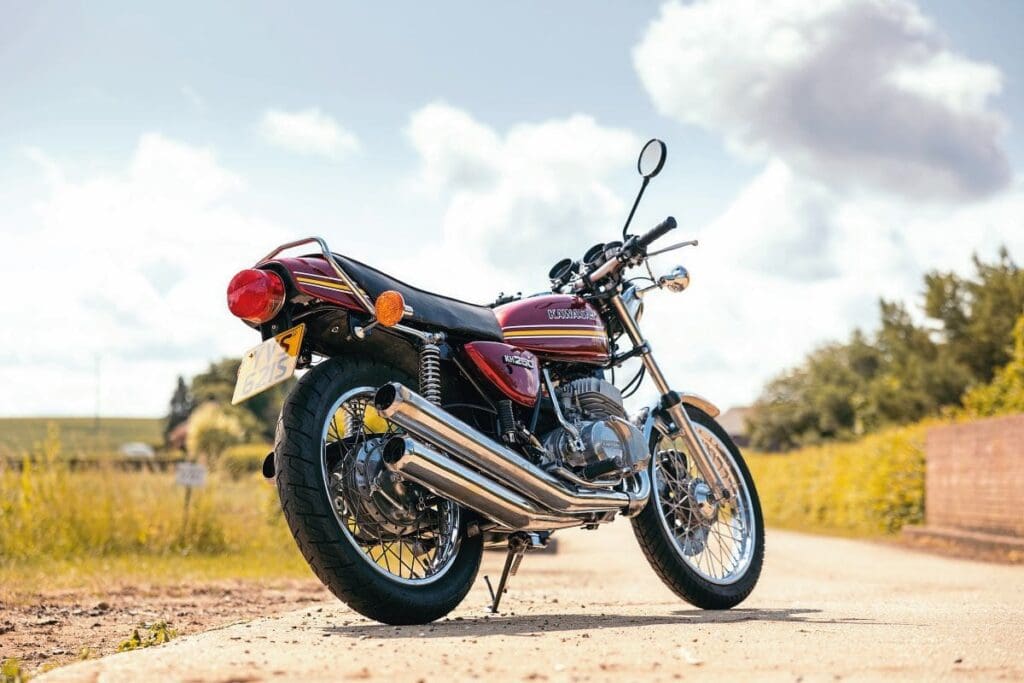
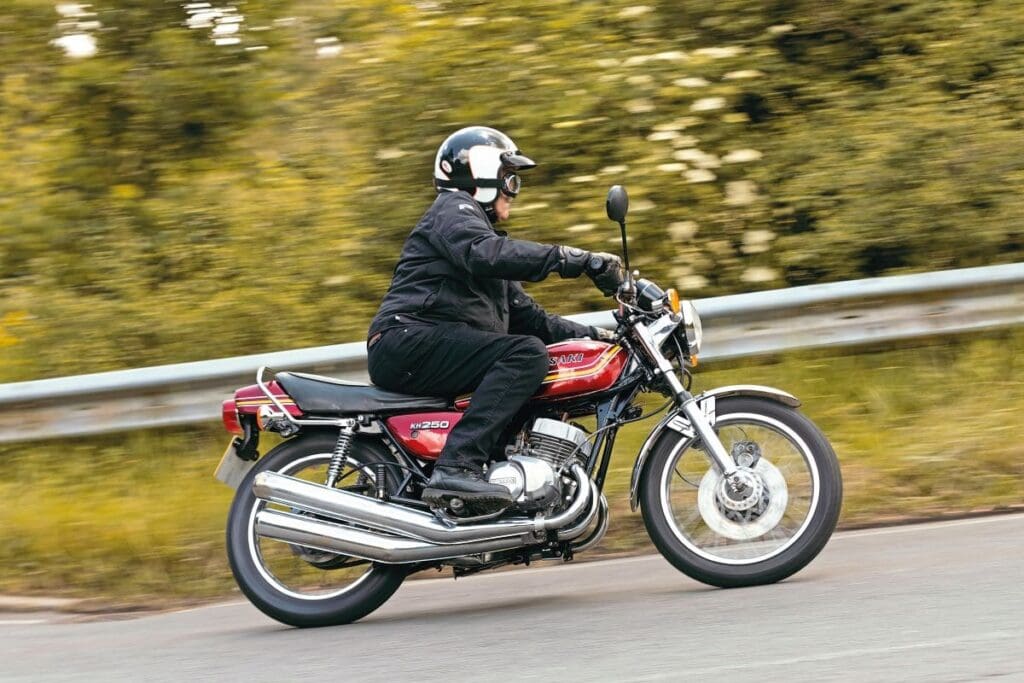
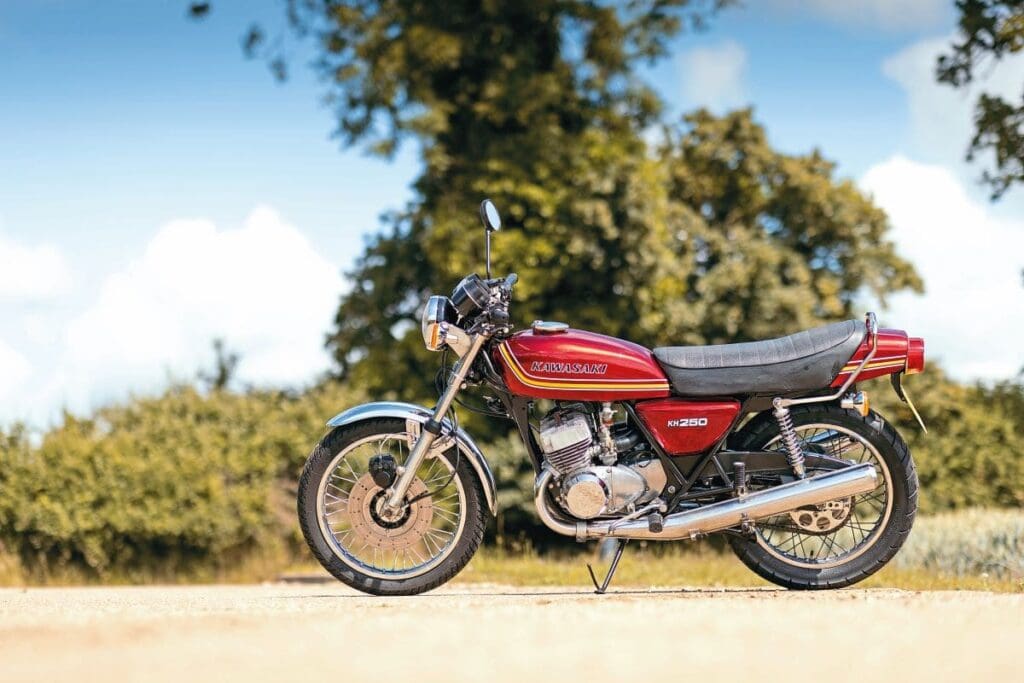
It’s interesting to have two supposedly ‘identical’ bikes in the one place. Production line changes can be small and often overlooked until you can carry out a side-by-side assessment. The red bike has its rear indicators mounted off the frame brackets under the seat, but the blue one has them on the grab rail even though the same frame brackets are present. Apparently, the red 250 runs a chrome rail from the older S series – a previous owner change or some old parts being used by the factory? One odd foible on both machines is a blind boss on the clutch case just below the kick-start. It’s positioning suggests the factory might possibly have been considering offering a longer gear shaft for a right-foot lever but no one seems to have a definitive answer. All we do know for certain is most of the 500s and 750s had the potential for a gear lever on the ‘wrong’ side.
Starting a KH250 is pretty much the same as any other Japanese stroker other than the choke. Kawasaki opted not to use carb-mounted, flip-down levers or a pull-out knob, instead favouring a bar-mounted lever on the left. Sited beneath the horn button, the lever is pushed inwards to operate the three chokes and held there until the motor fires. There’s no ‘friction hold’ facility so you’re permanently extending your thumb while kicking. Doubtless it becomes second nature to owners, but from a personal perspective it seems like an unnecessary faff and especially so knowing Suzukis utilised a position-holding wave washer at the pivot to make the process easier.
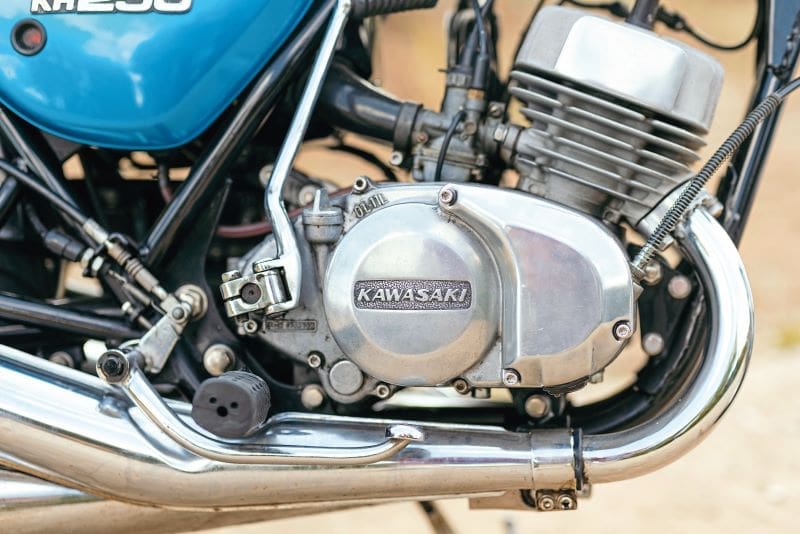
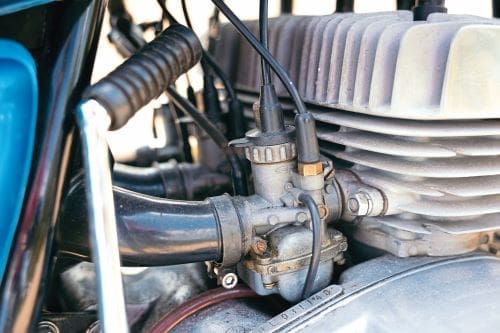
There is absolutely nothing quite like the sound of a small two-stroke triple and it’s both dramatically and significantly different to that of the 500s and 750s. Some have likened it to a jet engine and I can see why. It really is a singularly unique experience and I wouldn’t mind betting the factory went to some lengths to enhance the aural effects of those three pipes. This is unquestionably one of the bike’s exclusive features. Imagine being 17 and a salesman firing one of these up for you – you’d take the bait hook, line and sinker. Even now the sound of triples firing up stirs emotions and memories like little else. Tapped into gear and given some gas, the note changes from a melodic whiffle to a purposeful drone, then a full-on shriek as the revs climb under load. Even if the bike handled like a drunken giraffe wearing a blindfold while wearing ice skates, you’d still be suckered in purely because of the sounds. 120-degree motors are inherently smooth due to the physics involved, yet the KH250 does still have some vibes going on at certain revs. Whether this is due to harmonic couples resonating or Kawasaki engineering in something to ‘enhance the experience’ is open to debate, but the effect is never overly intrusive. The bike’s handling is more than fit for purpose and those that know the complete triples range well will tell you the 250/400 is actually one of the best engineered frames. Possibly they’re not as ‘tight’ as some of their contemporaries, but that said, the KH250 certainly isn’t not shabby around the bends.
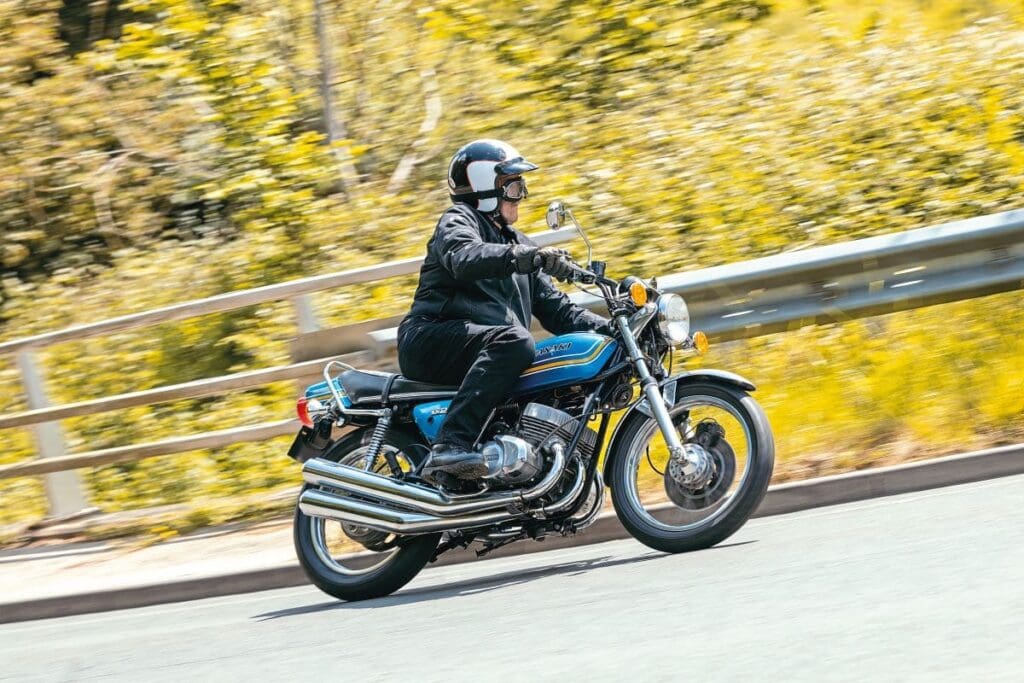
At the risk of the Kawa-nostra stalking me down and placing a broken crankcase on my pillow I’d have to say the bike’s brakes aren’t the best in class. The disc brake replaced had a rather average TLS (twin leading shoe) drum by the time the S series 250 became KHs, but the rear cable operated drum never changed. Politely put, the disc and caliper are ‘of their time’ and having sampled a KH400 with the same front anchor I’d respectfully conclude they’re okay but not outstanding. Compared to the brake used on the round-tanked RD250s, the Kawasaki unit lacks feel and bite. Apparently the unit is the same as that fitted to the Z900 but fortunately that did get a pair of them. And yet despite not being class leaders the brakes are certainly no worse than many of the period.
Some might suggest the 250 triple was an unnecessary complication when two cylinders would have done the same job but that misses the point entirely. The bike was created to get immediate buy-in or brand loyalty. The kids that bought one would be very likely to move on to 500 or 750 triple ownership during the S1’s tenure, or possibly a Z650 post KH250 once they’d passed their tests.
Hurtling around the back roads on this pair of 250s confirms there is one fundamental reason why these bikes remain so popular today – fun! You can experience the exclusive cachet that is Kawasaki three-pot strokers without too much of a price penalty (okay, a relative term); revel in that inimitable exhaust note; savour the only learner legal triple; and, when you plot up, drink in those exclusive lines. One of Kawasaki’s period adverts used to proclaim about letting the good times roll and despite the intervening decades I reckon they’re still doing just that!
Kawasaki 250cc Triple Genealogy
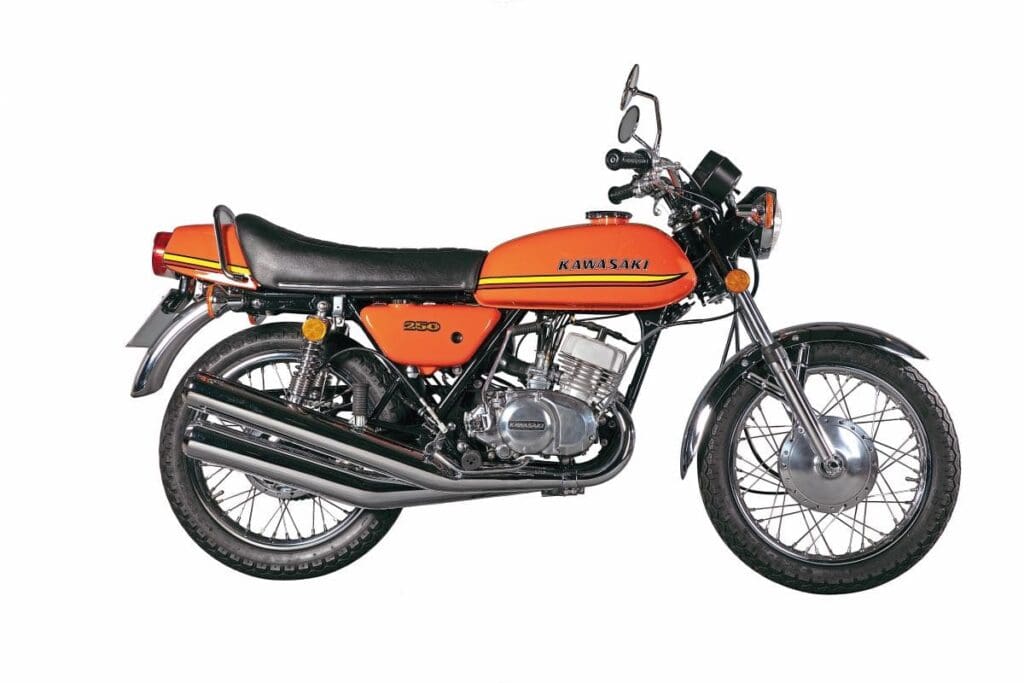
From technical and performance perspectives there is genuinely no reason whatsoever for the S1 and KH250 to exist. Truth be told, these gorgeous triples aren’t realistically an improvement over their forebearers. Those who know the marque well reckon that the previous A series Samurai twin was a better machine. Its disc-valve motor was genuinely faster and its chassis had better manners. However, the baby triple was a substantial facet of marketing and brand imagery. Someone high up decided back in 1971 that all the road-going strokers over 125 would sport three pots and so that’s what happened. There’s also a school of thought that suggests, development costs aside, the piston-ported triple was cheaper to make and assemble than the disc-valved twins.
Come 1972 the iconic S1 was unveiled, which immediately saw it plastered across all the bike publications. The press bikes were white with green stripes and tweaked to crack the magic ton – the seeds of success were sown and they instantly germinated. The S1 then gained a letter suffix A, B and C each model year until 1976 when there was a major marketing rebranding across all two wheelers in the range. All two-stroke road bikes became KH (Kawasaki Highway), hence the change from S1C to KH250. Styling followed the H1 and H2 lines, only the colours and graphics/decals/badges being 250 specific.
When Kawasaki began their transition to four-strokes it was first the 750 and then the 500 that were axed. The 400 followed a little later but, perhaps surprisingly, the KH250 hung on a lot longer. Why? Two reasons: firstly there were rumours of the forthcoming 125cc learner law, and secondly (and quite simply) the KH250 was still selling by the crate-load. Whereas Suzuki and Yamaha felt compelled to update, reconfigure and eventually redesign their 250s, Kawasaki felt no such obligation. There was nothing else available to learners that looked, sounded, or felt like those final KH250 B5s and Kawasaki knew it. They even went out in style by lettering the seat covers ‘KH’ for some bikes, thereby almost waving two fingers at anyone who couldn’t grasp the appeal of a two-stroke triple. Not a bad way to end a hugely successful lineage!
Owners’ stories: Laurence Kelly and Andrew Samways
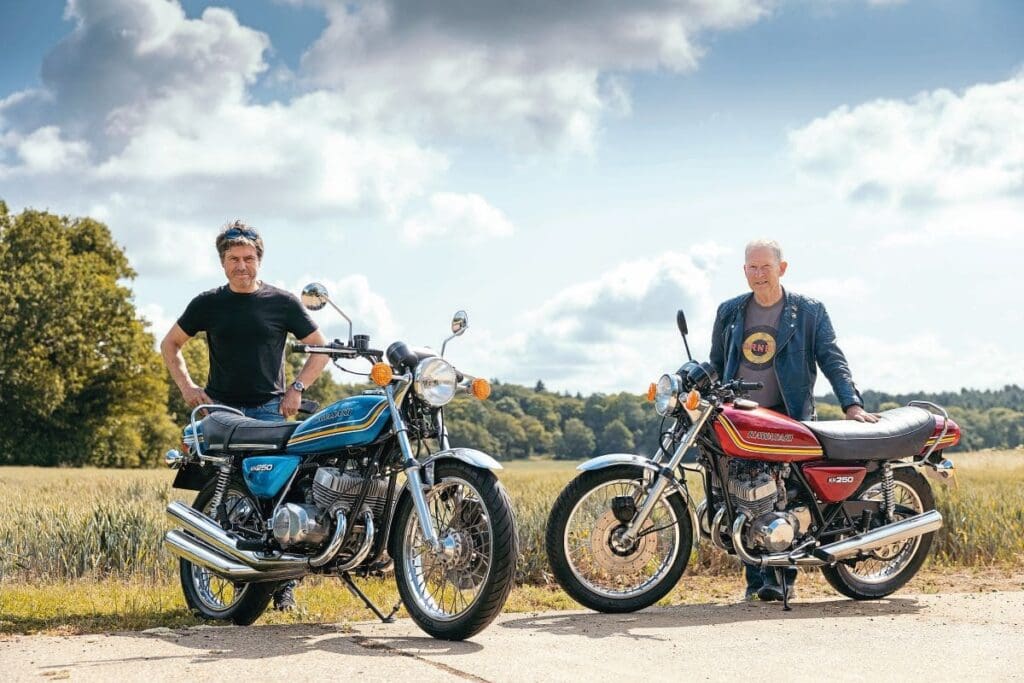
Laurence Kelly, owner of the blue KH250: “It was April 1977 and just about to leave Thomas Alleyne’s Boys School and what a brilliant time to be 16 with the sports moped revolution in full swing. All I could think of was getting my provisional licence and buying a bike. My best mate was slightly older than me and his big brother had just purchased a Daytona Orange BMW R90 S. It might have been from Hexagon London but all I knew was it was also a Kawasaki dealer as well. Anyway, he came away with the KH250 for my mate and the Beemer for himself. I received a phone call to go and have a look – oh my God, a two-stroke with three exhausts – it looked and sounded amazing, too. I was instantly hooked. RDs where nice but to my mind these Kawasaki triples were special (and still are!). My friend had to wait 12 weeks until his birthday before he could legally ride it on L plates, but what a lucky boy. It wasn’t until I was 54 that I finally acquired my 250, which is same year, different blue, but sounds just as special as it did back in the day. It’s a 1977 UK bike on an R plate and came via the Kawasaki Triples Club.”
Andrew Samways, owner of the red KH250: “YVS621S was first registered in the UK in June 1978 and before I became the owner and brought it back to life it had been off road since June 1981 so may never have had an MoT! I had plenty of leftover parts from past projects and with the help of the big family that is the Kawasaki Triples Club was able to source missing items. Good friends in the club helped do the paintwork and engine building. Many used parts went into it but the crank, pistons and some engine components were new. New taper roller headstock and swing arm bearings were fitted into the repainted frame. Some parts are getting difficult to find and a fuel tank (again through the club) was a good deal but still needed Steve Cooper to do a good clean inside. I was forever trying to filter out particles that were causing hassle on start-ups. The chain guard was a Stafford autojumble find in need of attention but it’s ended up looking good from a distance. Paintwork is from an earlier model but it’s one of my favourite schemes so that’s what I went with. It’s only recently been fully run-in so up until now I’ve been taking it easy. With all the help I’ve had it still adds up to a fair old cost and if I add up those hours in its resurrection it’s never going to be a bike to make me money. But it does give you that good feeling when it chirps into life. These small triples really do have a unique appeal.”
SPECIFICATION
Engine type: 249cc air-cooled, two-stroke, triple
Bore and Stroke: 45.0mm x 52.3mm
Claimed Horsepower: 28bhp @ 7500rpm
Maximum Torque: 19.5lb-ft @ 7000rpm
Transmission type: 5 speed
Compression ratio: 7.5:1
Carburetion: 3 x Mikuni 22SC
Tyres: 3.25-18 (F) 3.50-18 (R)
Fuel Capacity: 3.1 gallons (14 litres)
Brakes: 225mm disc (F), 180mm drum(R)
Dry weight: 160kg (353lb)